EXCERPTS FROM OUR COMTÉ SEMINAR

September 15, 2026 8 min read

EXCERPTS FROM OUR COMTÉ SEMINAR

Last week, Mons UK Director and Buyer Jane Hastings held an online seminar with our wholesale customers on all things Comté. The following is an excerpt from this seminar. 


Franche-Comté – a brief history  

Franche-Comté was first shaped by Celtic, Roman, and Germanic peoples before becoming the County of Burgundy in the 10th century, within the Holy Roman Empire. In 1127, Count Raynald III gained the title of “Free Count”, giving the region its name and a strong tradition of independence. Centuries later, through marriage and inheritance, the region came under the Dukes of Burgundy and eventually the Habsburgs and Spanish Crown. Under their Spanish rule, Franche-Comté flourished with high local prosperity and autonomy. It served as a vital military and geographic corridor linking Spanish-controlled Italy to the Low Countries. It was then in 1674 that Franche-Comté became a French annexation. 

In 1870, the Franco-Prussian War broke out, with France fighting a Prussian-led German coalition. As France collapsed, Franche-Comté became a major winter battleground, but the Fort de Belfort held out for 103 days, helping the region remain French while Alsace-Lorraine was ceded to the new German Empire. The conflict strengthened Franche-Comté’s strong French identity, and France later built a network of permanent forts along the new border - including forts that would eventually become famous Comté cheese cellars. The war also helped reshape France and Europe, setting the stage for World War I, and the Franche-Comté eventually became part of the modern Bourgogne-Franche-Comté region.


The geography, geology and socioeconomics of the Franche-Comté

The Franche-Comté's main geological feature is the massif du Jura, the Jura massive or the Jura mountain arc, so-called because it spans a 225-mile crescent shaped range that stretches from France through Switzerland and all the way into Germany - from the Rhone all the way through to the Rhine. The highest peaks of the Jura are in Switzerland reaching 1700 metres. The most famous French peak also happens to be the most famous cheese peak: the Mont d'Or, sitting a little lower, about 1450m.

More importantly, from a cheesemonger's perspective and from an agricultural perspective, the region has several main towns and cities, however is famous for having a huge number of tiny agricultural hamlets and villages dotted across the entire region. Famous too are the three main plateaux, rising in flat prairies that have slow hills that slope off it, ideal for grazing for its micro-diversity. It is however exposed to savage winds and brutally cold winter weather. Named for its dense forestation (the word jura meaning "forest" from the ancient Gaul jor/juria), the range is 66 million years old. Formed during the Cenozoic Era as part of the earth shift that pre-date the Alps, it grew in two distinct tectonic thrust phases: an outer low-lying French chain and a higher, inner Swiss range. Its fossil-laden limestone formations were the basis for naming the Jurassic Geological System & in turn, the Jurassic Period

 
Like its profusion of small villages and hamlets, the Jura also boasts a robust industrial economy that's driven overwhelmingly by small entities: medium, small and micro enterprises that employ 60% of the workforce in the region, and in the last 10 years generated 75% of all the new jobs. The industry in the Jura thrives across four key sectors:

  • The rather unromantic chemicals and plastics, born out of rock salt mining.
  • Timber mills and sawmills, developed, of course, due to the profusion of local forests.
  • Eyewear, watch and robotic manufacturers. 
  • Agricultural food production.

The aforementioned industries were born from farmers engaging in intricate indoor crafts in an attempt to diminish output and activity during bitter winter weather. With rugged mountains, limestone plateaus, dense forests, very long winters, but lush summers, the region’s climate and landscape prevented standard crop farming, pivoting communities towards dairy farming. Because the cold, high pastures can only be grazed during the summer, farmers had to transform their milk into large, long-lasting wheels of cheese.

As such, the conditions and terroir of the Jura, Doubs and Ain departments gave way to the ideal socio-economic conditions for Comté. 


The History, Cooperative System, and Regulation of Comté

The name Comté itself is an abbreviation of its original name – Gruyère du Comté. There's one story which relies on a kind of grandiose geographical mythology of eagles and winged lions, and on the Swiss side of the border, apocryphal tales of crane birds, known in French as 'Gru'. There is, however, an ancient tradition of forest rangers and tax collectors during the reign of Charlemagne, also known as 'Gruyèr'.

Historically, farmers in Alpine regions sometimes paid local taxes with cheese, which helps explain the old names “Gruyère du Comté” or “Comté du Gruyèr” - essentially, the tax collector’s cheese. A similar practice can be seen with Reblochon, whose name refers to taking the second milking after the tax collector had gone, allowing farmers to make extra cheese while paying less tax.

 
As for the recipe, Comt é originated over 1,000 years ago in the harsh, snowy Jura Mountains created by 12th-century monks, using pressed, cooked curd recipes to preserve summer milk. The region was incredibly poor, and farmers had very few animals with the average herd size being one or two cows. Unable to produce large wheels with the milk produced by individual farms, they pioneered a milk-lending system called the 'tour', pooling their supply daily. It was this collective effort that birthed the fruitières, some of the world's earliest agricultural cooperatives, with the first recorded in Deservilliers in 1253. Today, over 140 active cooperative dairies work in the region, supplied by 2,400 micro farms in the region of the Franche-Comté (around 6,250 square miles).   

To preserve its artisanal heritage, Comté was granted French AOC status in 1958 and upgraded to European Union AOP (Protected Designation of Origin) status in 1996, as such the interprofessionnel de Gestion du Comté (GIGC est 1963) is the regulatory body responsible for protecting its artisanal quality, mediating the supply chain, and leading global promotion. Comté operates under the Cahier des Charges, one of Europe's most rigorous agricultural rulebooks, regulating 

  • Terroir: All production, cheesemaking, and aging must occur within the Jura Massif. 

  • Core breeds: Only raw milk from 95% Montbelliarde and 5% French Simmental cows is permitted. Dairies must collect milk from farms within a tight 17-mile radius to protect local microflora.

  • Feed restrictions: When weather permits, animals feed entirely on outdoor, natural pastures; GMOs and fermented feeds (e.g. silage) are forbidden, to safeguard biodiversity and limit nitrogen fertilisation, caps limit stocking density, grass seed diversity, and milk productivity per hectare. Exceptions are only permitted in events of natural adversity i.e extreme drought.  

  • Artisanal process: Cheesemaking must initiate within 24 hours of milking. Raw milk is gently warmed only once in traditional copper vats. Artificial additives are prohibited.  

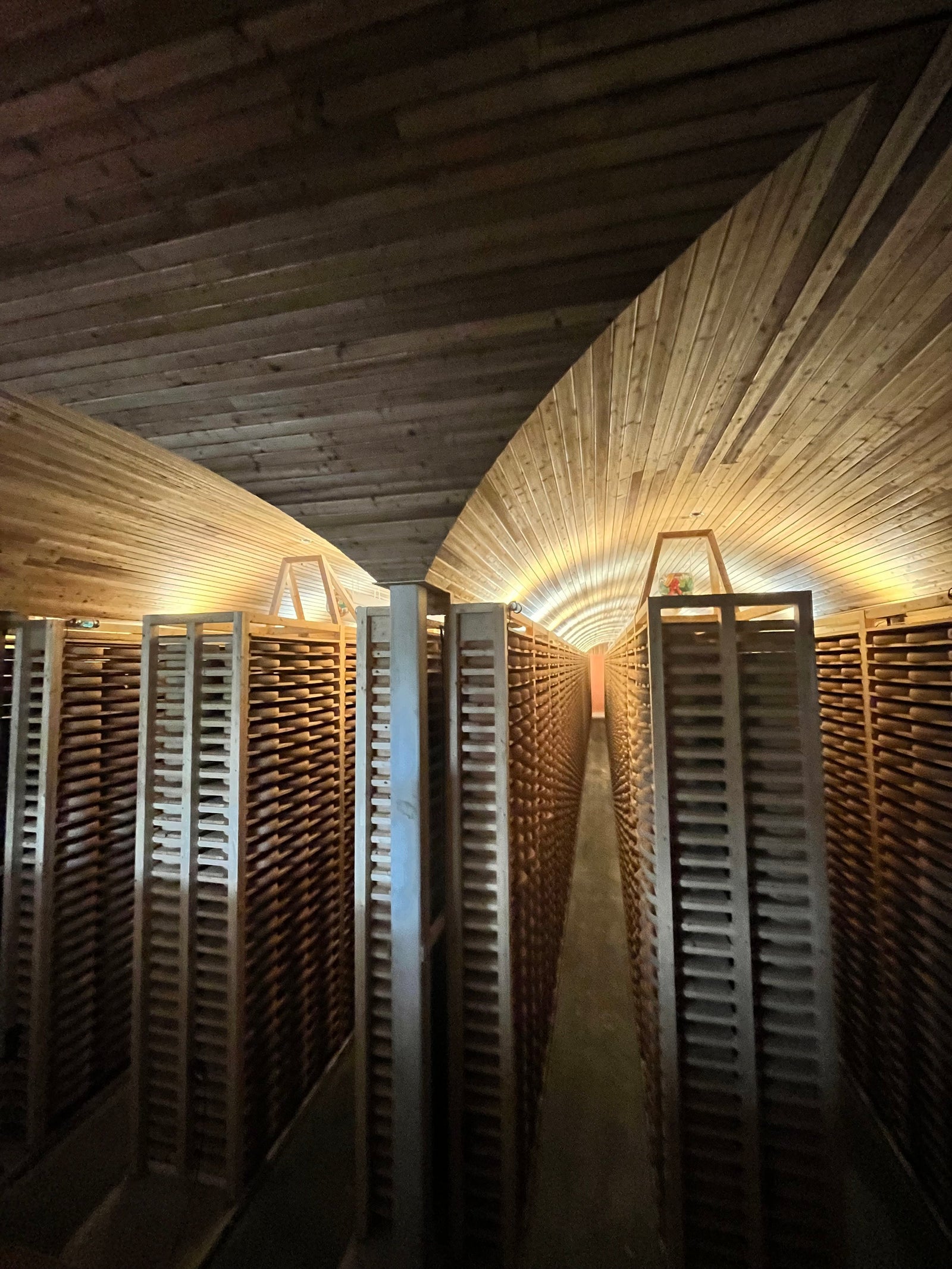
Rigorous aging and maturing protocols exist too, whereby all Comt é wheels must age exclusively on Jurassien spruce boards (fostering a local economy) which acts as a natural moisture regulator and retains the live, microbial flora from the cheese washing water, known as the 'morge'. Official maturing houses must reside in the AOP zone and facilities must feature a minimum of three separate, independently controlled cellars: 

  • Pre-maturing cellar: 10°C to 13°C to rest the cheese and form the early rind  

  • Fermentation Cellar: 14°C to 19°C at at least 92% (min.15 days)  

  • Maturing Cellar: 5°C to 10°C at least 90%. 

 
After four months, a body of professional inspectors and the chef de cave grade the cheese by taste (ironing) and by sound (tapping to listen for internal structural cracks). The cheese is graded out of 20 across 5 categories: 

  • Taste (9 points): Evaluates aromatic complexity (notes of hazelnut, brown butter, nutmeg). 

  • Texture / Body (5 points): Assesses elasticity, mouthfeel, and smooth or slightly crystalline structure. 

  • Internal Appearance (3.5 points): Checks structural integrity; small pea-sized eyes are allowed, but major cracks or large holes are heavily penalised. 

  • Quality of Rind (1.5 points): Inspects for a uniform, healthy exterior cultivated by the spruce planks. 

  • Overall External Appearance (1 point): Validates the physical symmetry, weight consistency etc. 

 
Wheels receive 3 possible categorisations based on their final score: 

  1. Green Band (15 to 20 Points): "Extra Comté", indicating the highest standard of excellence, with zero major structural flaws and a premium flavour profile. 

  1. Brown Band (12 to 14 Points): simply "Comté", denoting a high-quality, authenticity with good taste but minor cosmetic flaws (e.g., a slight rind unevenness or small micro-crack). 

  1. Disqualified (Below 12 Points): Banned from bearing the Comté name and rejected. Wheels are stripped of their casings and sold anonymously to industrial processors. 


Affineur: Rivoire-Jacquemin  

Rivoire-Jacquemin was founded by Alix Jacquemin in Monmorot in 1860, strategically chosen for access to salt from the local salt mining industry, water from the freshwater stream that came off the mountains and ran through the town, and the railway that ran behind their first caves, where the cheese was transported across France for sale. The company took its modern name in 1886 when Jacquemin's daughter, Eugénie, married Louis Rivoire. They’re the oldest, continuous Comte ageing house in France and they remain family owned and operated across five generations with Véronique Rivoire, Alix Jacquemin’s great-granddaughter, as CEO since the early nineties. In terms of their scale, Rivoire-Jacquemin have 38 specialised vaulted cellars, holding up to 120,000 wheels of Comte. In turn, they have far more dexterity and flexibility over how they want to mature the cheese.

To speak of Alix Jacquemin’s legacy, would be to speak of innovation. He revolutionised the industry, replacing the traditional practice of ripening cheese inside wooden barrels with modern subterranean cellar ripening. He also partnered with a local coppersmith to create the first steam-regulated heating and humidification systems, as well as pioneering the Comte industry’s early ethical supply chain by paying fruitières a premium, tied directly to the final quality of the cheese. 


At his sudden passing, Véronique left her successful legal career to assume leadership. She pivoted the house toward strict traceability, micro-terroir selection, and sustainable infrastructure. In her 35-year presidency and directing at Rivoire-Jacquemin, Véronique has gained the equivalent of an OBE, named Officier de la Legion of Honneur for inclusivity in the workplace, adding to her Chevalier du Mérite National in March 2007 (equivalent to an MBE). She was the first female Vice-president of the Comité Interprofessionnel de Gestion du Comté (CIGC) meaning she actively represents the institutional cheese-maturing body for all participants, not solely her family business, and stands out as the only female CEO across the 14 existing Comté maturing houses in the region, representing a powerful matriarchal paradigm in what is a male-dominated agricultural sector.

Her leadership is humble but proud, discrete but determined, idealistic but effective. She rejects corporate, formulaic approaches in favour of quality, fiercely defending artisanal non-standardisation. She famously maintains that "age is not a sign of quality", giving young, lively Comté the same culinary respect as 30-month extra-aged reserves, opening commercial possibilities evenly across the whole sector of producersShe believes that human sensory judgment - not calendars or automation - must dictate when a wheel has reached maturity

Véronique introduced an innovative cellaring technique, blending older, established cheese batches with incoming new arrivals to naturally propagate vital, wood-borne microflora across developing rind. In addition to uniform maturation across all 31 tiers of shelves, she has championed a major structural expansion, preserving regional architectural traditions by featuring entirely wooded vaults and thick, natural-stone walls which permit an air circulation that guarantees year-round, perfectly even temperature & humidity across an 8-metre high, 100m long maturing cave. Under her supervision, the company maintains a faithful, fair-trade relationship with 25 fruitières, comprising 400 milk producers, echoing the egalitarian, fair-trade business model of her great-great-grandfather.  


The Working Relationship: Mons Cheesemongers & Rivoire-Jacquemin 

Mons’ alliance with Rivoire-Jacquemin dates to the 1960s and is anchored in our mutual dedication to direct sourcing & selection, traditional farmhouse production, the legacy of Comté and to excellence in maturing.

We deeply appreciate the vision, impact and leadership of Véronique Rivoire. Her own and her company’s respect for clients (irrespective of size or revenue) who truly care to make an effort for what they sell, guarantees us a constant warm welcome without judgement or cynicism. They provide the forum for us to select cheeses to match our preferred flavour profile. Aged to the maturity that best enhances their character for our palates, enabling us to actively support an ethical, small-batch cooperative farming system that names & honours the individual fruitières whose cheeses appear on our shelves months later.

We visit the Rivoire Jacquemin caves a minimum of twice a year to select and reserve our cheeses with a view to aging them between 18-24 months, Once our wheels leave the Jura, we continue their long-term care here in Bermondsey, washing & turning them – at the hands of Peta and Martin 


We feel so lucky to work with such an amazing product, that can so effortlessly gratify to everyone who seeks it out.